

Appearance
Targeting Groups
A targeting group is a set of URL rules describing a slice of your site: your home page, every product page, every collection except clearance. Groups are reusable, and the Experiments screen groups your tests by them.
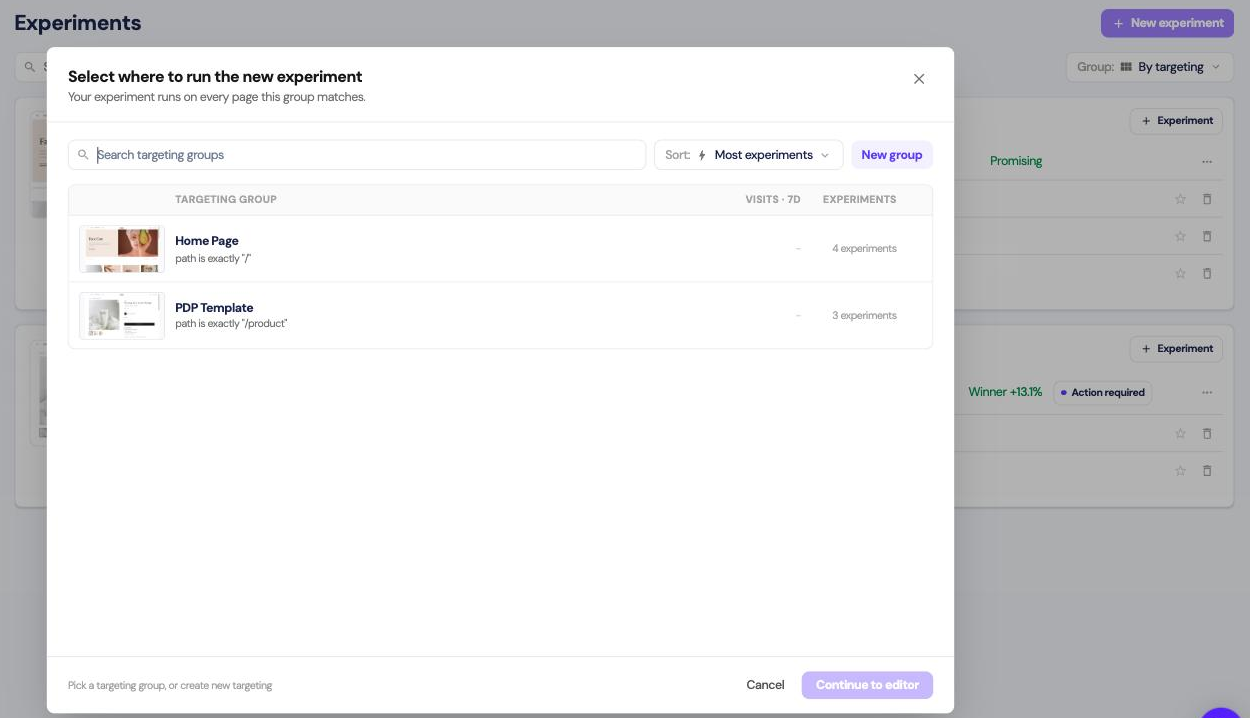
Starting a new experiment opens this picker. Each group shows its traffic over the last 7 days and how many experiments use it.
Building a group
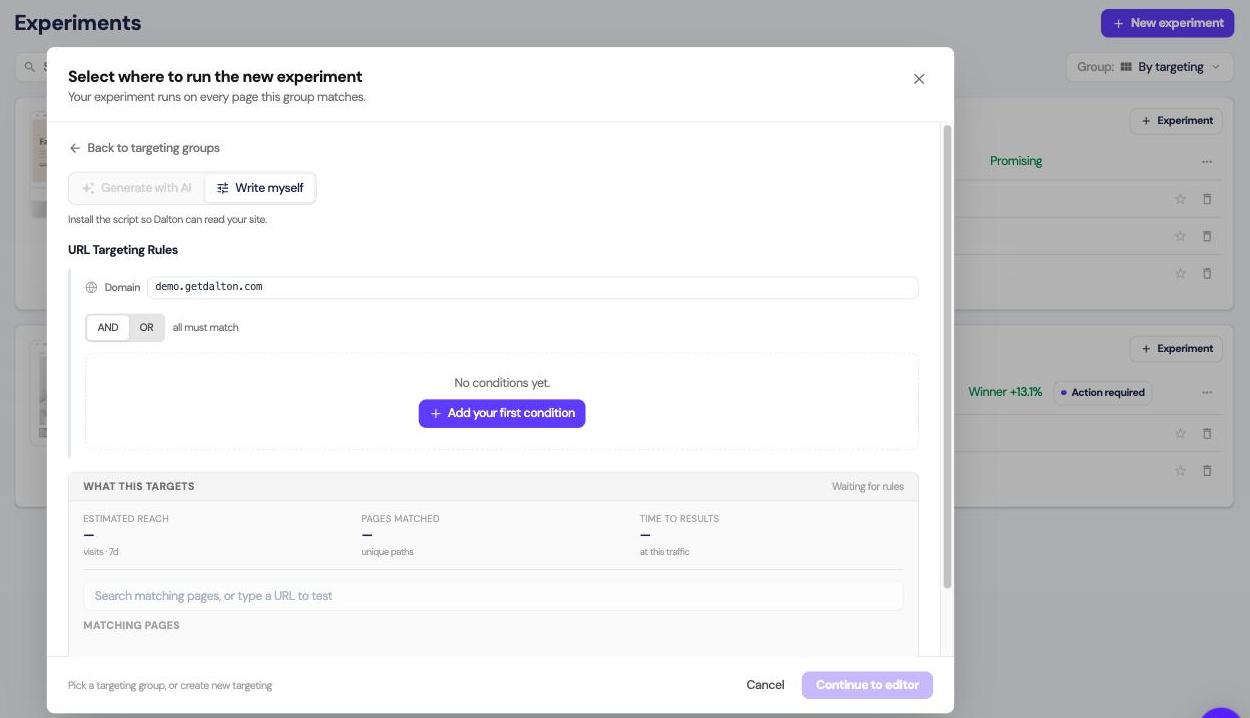
Generate with AI describes the pages in plain language and lets Dalton write the rules. It needs the Dalton script installed, since it reads your actual site. Write myself gives you the builder directly.
Rules
Each condition reads as: path does or does not [operator] [value].
| Operator | Matches when the path |
|---|---|
| Exact match | is exactly the value |
| Simple match | equals the value, ignoring query parameters |
| Starts with | begins with the value, such as /products |
| Ends with | ends with the value |
| Contains | contains the value anywhere |
| Wildcard | fits a pattern, such as /products/* |
| Regex | matches a regular expression |
Combine with AND or OR, and nest groups for anything more involved.
Rules match the path only. Query strings and # fragments are stripped first, so /products/serum?utm_source=meta is tested as /products/serum.
The reach panel
As you build, the panel underneath shows:
- Estimated reach, visits in the last 7 days
- Pages matched, distinct paths covered
- Time to results, how long a test on this group would run
Time to results uses the same calculation as an experiment's planned window, so you can see before launching whether a group resolves in two weeks or six. Use the search box to type a real URL and confirm it matches.
Choosing the scope
A rule matching 40 product pages resolves in a fortnight where one matching a single page may never resolve. Widen for generic changes such as trust badges or delivery messaging. Narrow when the change only makes sense on one template.
One constraint: only test elements that exist, and mean the same thing, on every page in the group. See Multi-Page Experiments.